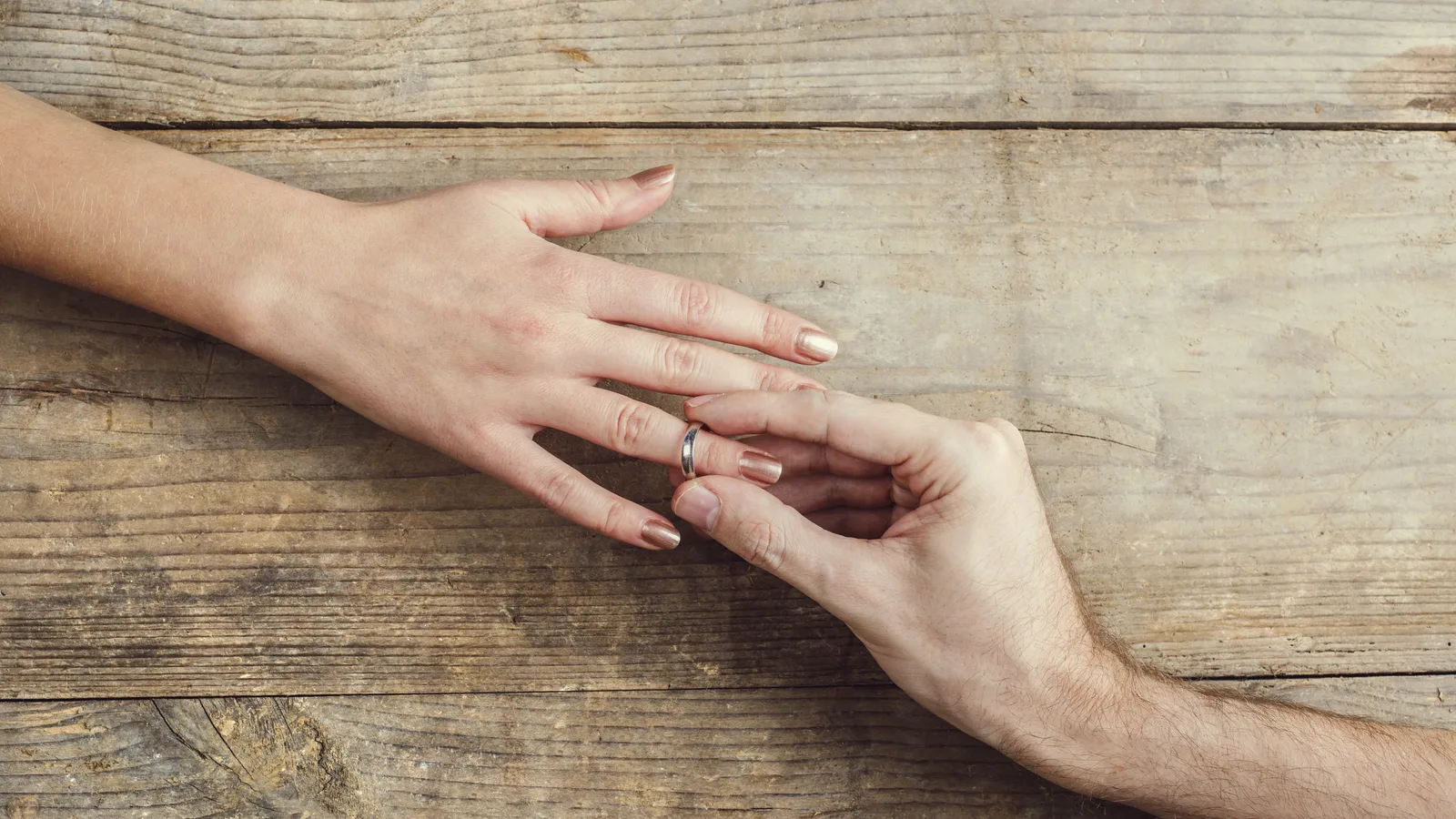
How to Find Your Ring Size at Home: A Simple Method
Measure your ring size at home in minutes: two simple methods, how to read UK letter sizes, and the mistakes that lead to a ring that spins or won't budge.
The short answer
Your ring size is a measurement of the inside of the ring — its internal diameter or its circumference — matched to a letter on the UK sizing chart. There are only two things you can measure: a ring that already fits, or the finger itself.
The quickest reliable route is to take an existing ring that fits the same finger, measure across its inside edge in millimetres, and look that figure up on the size chart of the shop you're buying from. No ring to hand? Wrap a narrow strip of paper round the base of your finger, mark where it overlaps, and measure the length flat — that length is your circumference.
Either way, the number on your ruler means nothing until you check it against that shop's own chart. UK sizes are letters, they vary slightly between jewellers, and half sizes sit in between.
What you need before you start
- A ring that fits
- One you already wear on the finger you're sizing, with a band width close to the ring you're buying.
- A ruler
- A straight ruler marked in millimetres. A narrow dressmaker's tape works for the finger method.
- Paper or string
- A strip about 1 cm wide and 10 cm long, plus a pen to mark the overlap.
- The shop's size chart
- The UK letter chart from the jeweller you're buying from — not a generic conversion table.
- Ten minutes
- Best done in the afternoon or evening, with warm hands, and repeated on a second day.
Method 1: measure a ring that already fits
1. Choose a ring that fits the right finger
Use a ring you already wear comfortably on the exact finger you're sizing, ideally with a band width close to the new one. A 2 mm band and a 6 mm band can feel a full size apart on the same finger.
2. Check the ring is still round
Rest it on a flat surface and look at it side-on. A band that has been squashed or worn thin at the back gives a reading that's too small — have it straightened by a jeweller, or use a different ring.
3. Measure inside edge to inside edge
Lay the ring flat and place the ruler across the middle, running from the inside of one side to the inside of the other. Read across the widest point through the centre: not the outside of the band, and not the thickness of the metal.
4. Take three readings
Rotate the ring between measurements and write each figure down. If they agree to within about 0.2 mm, trust the number. If they don't, the ring is out of shape.
5. Match the figure to the shop's chart
Find the internal diameter column on the jeweller's UK chart and take the nearest letter. If you fall between two sizes, choose the larger — especially for a wide or stacking band.
Method 2: measure your finger directly
1. Cut a strip of paper
About 1 cm wide and 10 cm long is plenty. Paper is better than string, which stretches as you pull and will make your size come out too big.
2. Wrap it round the base of your finger
Slide it just below the knuckle and pull it snug: firm against the skin, but not tight enough to leave a mark or dent the flesh.
3. Mark where it overlaps
Hold the join with a fingernail and draw a pen line straight across both layers where the end crosses the strip. A line drawn at an angle adds a millimetre or two.
4. Measure the strip flat
Lay it out against the ruler and measure from the end to your mark, in millimetres. That length is the circumference of your finger.
5. Check it clears the knuckle
Slide the loop off over your knuckle. If it catches, the ring will too — size for the knuckle rather than the base of the finger, and expect the finished ring to turn a little once it's on.
6. Look up the circumference
Some charts list circumference, others only internal diameter. Use whichever column the chart gives and don't convert between the two by eye.
Which method should you use?
All four routes work; they suit different situations and carry different risks.
Method
Best for
- A ring that already fits
- Anyone with a ring on the same finger
- Paper strip
- Fingers with no ring to copy
- String
- A rough first check
- A jeweller's ring gauge
- Anything expensive, engraved or made to order
- Printed chart or plastic sizer
- A cheap second opinion
How accurate at home
- A ring that already fits
- High, if the band is round and similar in width
- Paper strip
- Good, as long as the paper doesn't crease or stretch
- String
- Lower — string stretches and sits unevenly
- A jeweller's ring gauge
- Highest
- Printed chart or plastic sizer
- Varies — printing scale must be exactly 100%
Watch out for
- A ring that already fits
- Reading the outside of the band rather than the inside
- Paper strip
- Marking the overlap at an angle
- String
- Pulling it tight round the finger
- A jeweller's ring gauge
- Measure on a normal-temperature hand, not one just in from the cold
- Printed chart or plastic sizer
- A printout that's been enlarged reads a size or two out
Reading UK ring sizes without getting it wrong
UK ring sizes are given as letters, running up from A, with half sizes in between — an L½ sits between L and M. Each full letter step is small, roughly 1.2 mm of circumference, which is why half sizes matter on wide bands and why guessing rarely lands.
Those letters are not an international standard. A UK N, a US 6½ and a European 53 sit close together but are not identical, and different jewellers nudge their charts by a fraction. So:
- Use the chart published by the shop you're buying from, not a generic conversion table.
- Check whether it gives internal diameter or circumference, and match like with like.
- If a ring is being made for you, ask the maker which measurement they work from.
- Never scale a printable chart by eye — it's only accurate printed at 100%.
When to measure your finger
Fingers are not a fixed size. They swell a little in warm weather, after exercise and towards the end of the day, and they shrink in the cold. A ring measured on a frosty morning can be uncomfortably tight by the evening.
- Measure in the afternoon or evening, with warm but not hot hands.
- Don't measure straight after a workout, a hot bath or a long walk in the cold.
- Take the reading on two different days and compare them.
- Measure the finger you'll actually wear the ring on. The same finger on the other hand is often a different size, and the hand you write with tends to run slightly larger.
What commonly goes wrong
- Measuring the outside of the band. The outer diameter includes the metal, so the ring comes out a size or two too big.
- Pulling the paper or string tight. Any squeeze flattens the finger and shrinks the reading. Snug is the target, not tight.
- Marking at an angle. A slanted pen line adds length; draw straight across both layers.
- Reusing stretched string. Paper or a narrow tape gives a more honest figure.
- Sizing for the base of the finger only. If your knuckle is wider than the base, the ring has to pass over it.
- Assuming a size travels between shops. Always re-check against the seller's own chart, even if you've bought the same letter before.
Rings that need a different size
Band width and shape change the fit even when the measurement is right.
- Wide bands, roughly 6 mm and above, feel tighter than narrow ones in the same size, so go up half a size.
- Stacking rings take up room on the finger: size the whole stack, not just the main ring.
- Heavy or top-set rings turn on a finger that's slightly loose, so the ring spends the day with its stones under the finger rather than on top.
- Rings that can't be resized — full eternity bands set with stones all the way round, tension settings, and some channel-set or patterned designs — are worth getting right the first time.
If it's a surprise
You can size someone else's finger without asking. Borrow a ring they wear on the same finger — the bedside table or bathroom shelf usually obliges — and measure the inside diameter as in Method 1.
Note which hand and which finger it came from, because a dress ring worn on the index finger tells you nothing about the ring finger. Then compare the borrowed ring's band width with the one you're buying: a slim band and a wide band in the same size do not fit the same way.
Before you order
Get the measurement confirmed before money changes hands. In a shop, ask to be measured with a proper ring gauge; it takes seconds and removes the guesswork. Online, check the returns and exchange policy for sized, engraved or made-to-order rings, because those are often excluded from the standard cooling-off terms.
Some jewellers will post out a plastic sizing gauge, which is a far better double-check than a printed chart. If you're ordering a ring that can't be altered later, it's worth being measured twice, on different days, before you commit.
Frequently asked questions
Is my ring size the same on both hands?
What if I'm exactly between two sizes?
Can I use a tape measure instead of paper?
Does a wider band need a bigger size?
Can every ring be resized later?
Related articles
How to clean silver: restore its shine safely at home
Learn the gentlest, most effective way to clean silver at home, from mild soap washes to polishing cloths, foil baths and tarnish prevention.
How-To Guides
The best way to moisturise skin: a routine that works
Apply moisturiser the right way: damp skin, thin-to-thick layering, the right texture for your skin type, and the mistakes that keep skin tight.
How-To Guides
How to build a capsule wardrobe that works every day
A practical, step-by-step guide to building a capsule wardrobe you actually wear: choosing a palette, editing what you own and filling only real gaps.
How-To Guides
How to layer skincare in 6 steps: the order that works
A clear, step-by-step guide to layering skincare: the right order, how long to wait between layers, and how to avoid irritation and pilling.
How-To Guides
How to style a blazer: fit, layers and finishing touches
Learn how to style a blazer with a clear fit checklist, six styling steps and fixes for the common mistakes — from office tailoring to weekend denim.
How-To Guides
How to Style Boyfriend Jeans: 6 Steps to a Relaxed Look
Learn how to style boyfriend jeans with a six-step method: choosing the right fit, cuffing, balancing volume, layering and finishing with the right shoes.
How-To Guides
How to Style Wide Leg Jeans: 6 Steps to a Balanced Look
Learn how to style wide leg jeans with balanced proportions: hem lengths, shoe pairings, tucks and belts, plus fixes for common fit mistakes.
How-To Guides